The Public Transport Delusion: Why Colectivos Will Ruin Your Trip
Let’s be completely honest about moving around the Yucatan. The internet lies to you. You see these videos of backpackers happily jumping into the back of a white "colectivo" van, smiling as they ride down Highway 307. It is a highly curated fantasy. The reality is a brutal test of endurance. You stand on the side of a scorching, dusty highway with semi-trucks blasting past you at eighty miles an hour. The gravel bites through your sandals. You wait forty minutes in the blinding sun. When a van finally stops, you are crammed shoulder-to-shoulder with fourteen other sweating humans. The air conditioning is a joke. You breathe in cheap cologne and exhaust fumes. And the worst part? They drop you off on the side of the highway, miles away from the actual jungle cenote you wanted to see. You are left standing in the dirt, completely at the mercy of a local taxi mafia guy who wants thirty dollars to drive you the last two miles. I refuse to travel like livestock. If you actually want to see the remote, silent ruins and the deep, cold sinkholes, you absolutely must have the keys to your own car. You need the heavy doors to lock. You need autonomy.
The Airport Extortion: Skipping the Corporate Rental Desk
But do not just blindly walk up to the brightly lit rental desks at the Cancun or Tulum airports. I consider them legalized extortion. A guy in a crisp white shirt will smile at you, hand you a contract entirely in Spanish, and quietly place a three-thousand-dollar hold on your credit card. They invent mandatory insurance policies on the spot. They hunt for microscopic scratches on the plastic bumper when you return the car, charging you hundreds for damage you didn't do. I stopped playing their rigged game years ago. I bypass the airport circus entirely.
I use Localrent.com now. To my mind, it is the only logical loophole left in Mexico. They connect you directly with local Mexican fleet owners. I met a guy named Carlos in a dusty gravel lot behind a gas station in Playa del Carmen. I handed him a small cash deposit. He didn't even look at my credit card. He handed me the keys to a battered, reliable Nissan March with heavily tinted windows. He didn't try to upsell me on useless tire insurance. He just told me to watch out for the giant potholes near Coba. It was startlingly human. The car was not pretty, but the air conditioning was violently cold, and my bank account stayed perfectly safe.
Prepping the Machine: Cold Air and Dead Zones
Before you hit the gas, you have to physically test the machine. Driving in the Mexican jungle is completely unforgiving. First, blast the AC. The midday heat radiating off the asphalt will physically cook you inside the cabin. If it doesn't freeze your face in thirty seconds, reject the car. Second, physically check the trunk for a spare tire and a rusted jack. I once blew a tire on a sharp, jagged rock near the Sian Ka'an reserve. Waiting three hours for an angry tow truck driver in the mosquito-infested jungle fundamentally changes your brain chemistry. And when you hit the Pemex gas stations? Do not zone out. Hand them a five-hundred peso bill. Watch their hands. Make sure the pump actually starts at zero. Tip the attendant a ten-peso coin. Cash is basic survival gear out here.
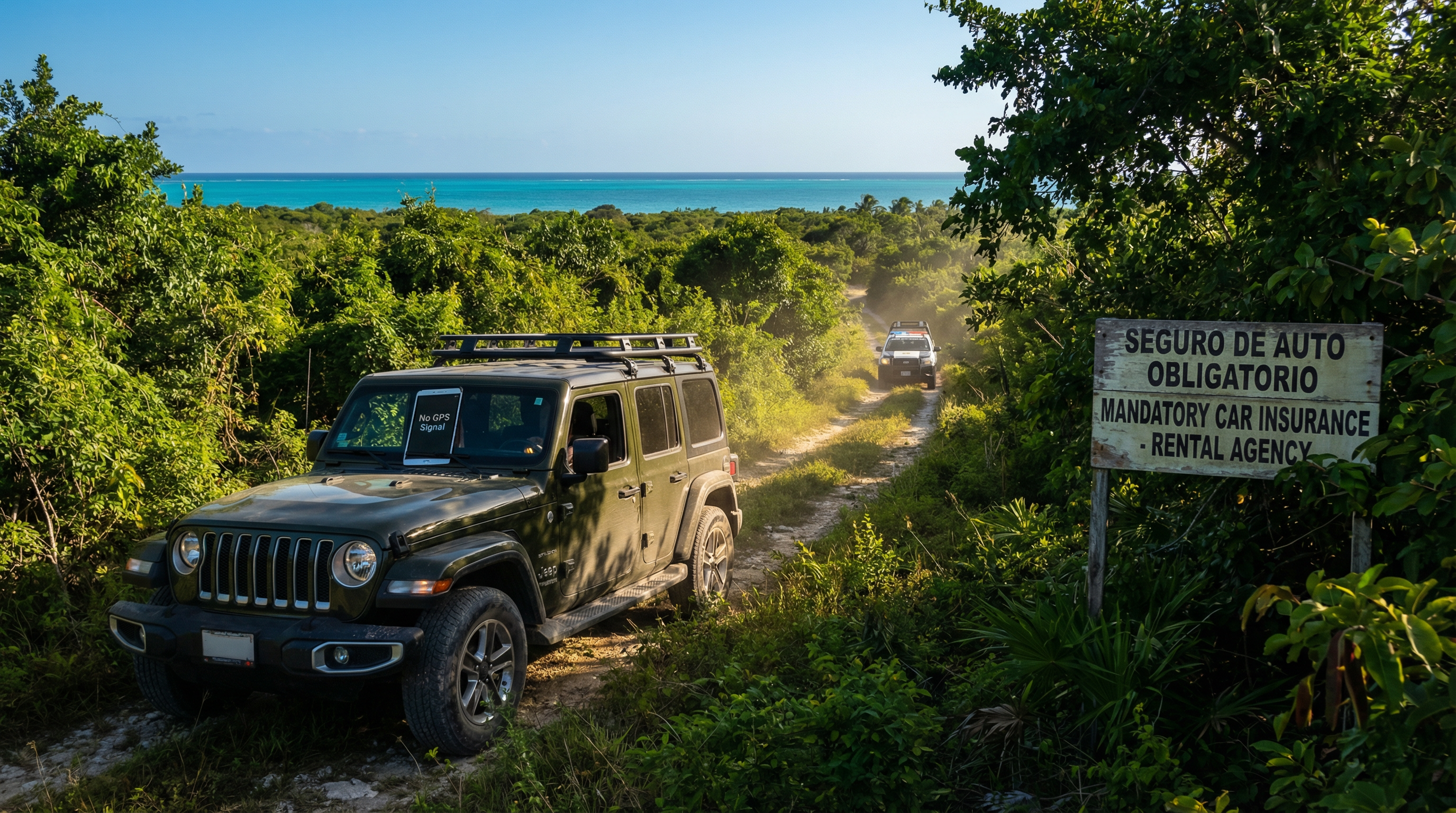
Driving blind in the jungle is a modern nightmare. I think getting lost sounds romantic right up until the sun drops below the tree line. The shadows stretch out across the asphalt. The road suddenly turns to packed white dirt. Your GPS map instantly goes gray. The "No Service" text blinks in the corner of your screen. Panic hits the back of your throat. I refuse to rely on spotty hotel Wi-Fi or buy cheap plastic SIM cards at the OXXO convenience store. Dealing with a tiny metal pin on a sticky dashboard is pathetic. I installed a Yesim eSIM while I was still drinking coffee at my departure gate in the US. By the time the landing gear hit the cracked tarmac, my phone grabbed a heavy, unbroken 4G LTE signal. I kept that signal deep inside the dark, isolated dirt roads of Francisco Uh May. You need that digital lifeline. You need it to translate a handwritten menu or find your way back to the highway in the pitch black. Secure the connection before you leave.
The Two-Day Escape: Dark Water and Rusted Pyramids
Day 1: The Deep Green
- The Cold Sinkhole: Do not go to the Gran Cenote. It is a crowded, expensive swimming pool. Drive twenty minutes south of Tulum on the 307. Look for a hand-painted wooden sign for Cenote Escondido. You pay a guy sitting on a plastic chair in the dirt a hundred pesos. You drive down a rutted jungle track. The water is freezing, dark green, and incredibly deep. Tiny fish bite at your toes. It is completely silent except for the birds.
- The Jungle Ruins: Drive another ten minutes south to Muyil. It is not massive like Chichen Itza. It is small, steep, and completely swallowed by thick, dark green jungle vines. You climb the steep stone steps. Your lungs burn in the humidity. You look out over the flat, unbroken canopy towards the Sian Ka'an lagoon. There are no massive tour groups here.
- The Hot Pork Fat: For lunch, do not eat near the ruins. Drive into the dusty town of Felipe Carrillo Puerto. Find a plastic table under a tin roof on the side of the road. Order tacos al pastor from a guy slicing pork off a spinning spit. The hot pork fat coats the roof of your mouth. The sweet pineapple cuts the grease. The aggressive green salsa literally burns your lips. It costs two dollars. It is a culinary masterpiece.
Day 2: The Empty Coast
- The Turtle Beach: Drive north towards Chemuyil. Turn right down a terrible, pothole-filled dirt road towards Xcacel. This is a protected sea turtle sanctuary. There are no massive beach clubs pumping terrible house music. There are no expensive cabanas. Just white sand, aggressive waves, and total isolation. You pay a small conservation fee at the gate.
- The Local Seafood: After the beach, drive into the tiny village of Chemuyil. Find a spot called La Palapa. The plastic chairs are sticky. Order the whole fried fish. It comes out staring at you, covered in aggressively sharp garlic and lime juice. You eat it with your hands, drinking a sweating bottle of Victoria beer. It tastes like pure, unadulterated survival.
Surviving the Asphalt: Bribes, Bumps, and Paranoia
Driving here requires intense paranoia. The roads are a physical assault.
- The Spine Breakers: You have to watch out for 'topes'. They are massive, yellow concrete speed bumps. They are completely unmarked half the time. They sit in the dark shadows of trees. If you hit one at forty miles an hour, it will violently destroy your suspension and launch you into the roof. You constantly stare at the asphalt.
- The Federales: The police checkpoints are intimidating. Heavily armed Federales stand in the middle of the highway. Usually, they just wave you through. But sometimes, the local traffic cops pull you over for completely invented reasons. "Your headlights are too bright." "You merged incorrectly." They will try to confiscate your driver's license and tell you to go to the station to pay a massive fine.
- The Standoff: Do not panic. Do not immediately hand them fifty bucks. Smile. Play dumb. Speak only English. Ask for the physical, written ticket. "Multa, por favor." Nine times out of ten, they realize you are too much paperwork and they will angrily wave you away. Never hand over your actual passport. Give them a cheap photocopy.
Driving the Yucatan is a brutal stress test. You just have to commit. Pay the tolls. Drink the cheap beer. Smell the burning jungle wood. You drive it on your own brutal terms.